In this issue
The Open
|
The few millimetres of liquid, oil or brine or tomato, do not announce themselves as food. The fish goes into the can raw, unless it was grilled or smoked, and the lid goes on before any cooking has happened, so whatever was poured in alongside it is the thing the fish then gets cooked in, kept in, and quietly altered by for as long as the tin sits unopened.
A cannery seals first and cooks second. Once the lid is seamed on, the cans go into a retort, a big pressure vessel, and are held at somewhere around 116 to 121 degrees, long enough to sterilise everything inside. Nothing can be stirred or tasted or adjusted once they are in this state. The heat has to travel to the middle of the fish, and it travels through the liquid, which is why the liquid decides the cook and not just the taste. Brine carries heat faster than oil. In one trial on yellowfin, the brine-packed cans reached holding temperature in about fifteen minutes where the oil-packed took twenty-six.
Then the exchange begins. Fat dissolves fat, so an oily fish in oil gives some of itself up to the oil around it, and analyses of oil-packed tuna have found that pouring that oil away takes a share of the fish's own omega-3s with it. Water-packed fish holds on to more of them, oil and water declining to mix, but the brine takes its own cut in the things that do dissolve in water, the salt-soluble savour that ends up in a liquid nobody keeps. Oil is the one where what is left is worth eating most.
Olive oil is the Iberian and Breton answer, the slowest and the most protective, a medium that shields the fat from turning and lets a good tin go on softening and deepening for years. Brine is the plainest, handing you the fish and very little else, which is what you want when the tin is heading into something that brings its own sauce. Tomato is a cooked sauce in its own right, acid and a little sweet, seasoning the fish rather than protecting it, and it is what most of the world's sardines are packed in, the everyday tin of Morocco and Portugal and the Baltic ports and the British table.
A cannery cannot make its fish better by changing what it pours in, but it can make the tin dearer or cheaper by a wide margin, because good olive oil costs a multiple of sunflower, and that is why the label draws such a careful line between olive oil, vegetable oil, and the blend that says both. Europe's marketing standard for preserved sardines even polices the pack itself: in an oil tin, the watery exudate that seeps out of the fish is not allowed to run past eight percent of the net weight.
Everything a tin becomes between the cannery and your kitchen, it becomes through that liquid. Warm a good one, tip it out over the bread along with the fish, and understand that the pour is not a garnish. It is the other half of what you bought.
Affiliate · Mercado Central NYC
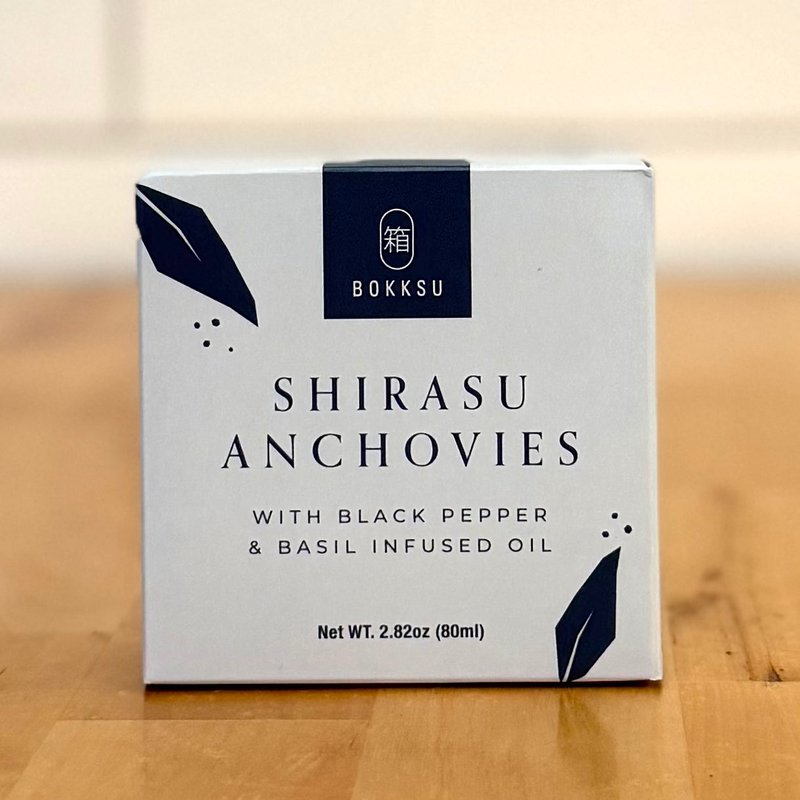
Japanese Shirasu Anchovies Black Pepper & Basil-Infused Oil
At Mercado Central NYC: New York-based retailer curating tinned fish and conservas from Spain, Portugal, and the broader Mediterranean.
Visit store →The Market Report: the week's real price drops and deals. Free, every Saturday.
The Tin
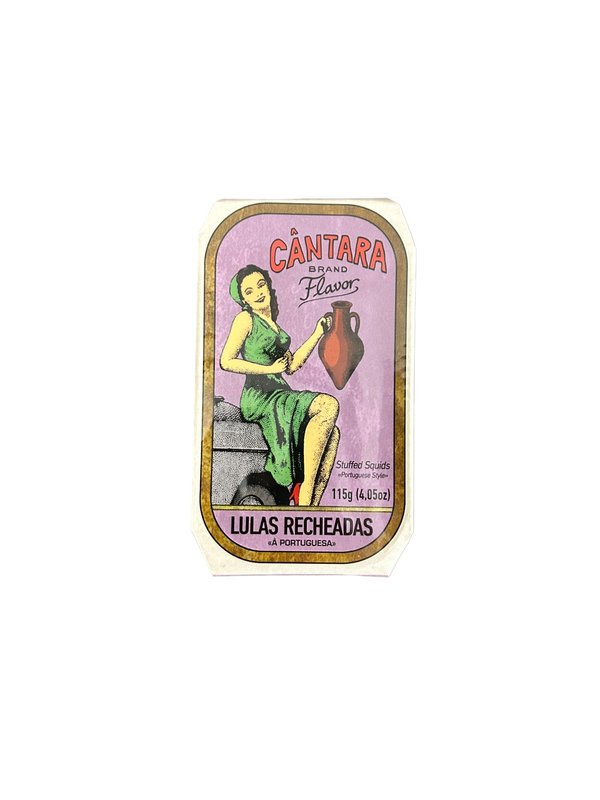
Stuffed Squids, Portuguese Style
In the issue, 15 August
$48
Today, 4 October
––Delisted
A small squid, stuffed with a larger one, by hand.
Issue 3 told the first half of this house's story: the Lazzara brothers walking away from their Italian fish factory in the 1920s rather than supply Mussolini's army. Carlo Lazzara's salting warehouse on the Rua do Godinho passed to his daughter Girolima and her husband, then to their son, who was sent to the colonial war and emigrated in the unsettled years after the 1974 revolution. Around 1977 he handed the firm and its brand to Fausto Cântara, who until then had kept the books at another Matosinhos cannery. Cântara's son runs it now.
The Cântara line is the artisan end of it, and this is the strangest tin on it. Small squid are stuffed by hand, one at a time, and what they are stuffed with is more squid: chopped giant calamari, with onion and rice, in a light tomato sauce. Nothing about it can be done by machine, which is why almost nobody makes it.
The little squid stay tender, the rice inside them takes up the sauce, and the whole thing eats like something that came out of a Portuguese kitchen rather than off a line. Warm the tin through and put it on bread, or tip it over plain rice and let the sauce carry it.
$48 for a pack of six at TinCanFish.
What are you opening this week? Tell us →
The Radar
Cantabria reopens.
Spain has reopened the Cantabrian anchovy fishery on the back of a quota increase. It is also the one corner where our own price data found real movement: tins are flat everywhere except Spanish and Cantabrian anchovy, which had firmed by four to eleven percent. More fish in the water is the first thing that would take the pressure off.
Hokkaido waits for a fishery that never arrived.
Japan's Pacific sardine season has effectively collapsed, because the fishing grounds off eastern Hokkaido did not form this year. It lands in the same season that nine economies cut the Pacific saury quota by five percent and Japan headed toward its lowest saury landings in fifty years, with Hokkaido down about forty percent. Hokkaido is where a great deal of Japan's canning supply comes from, so the saury and sardine tins on the Japanese shelf are the ones to watch.
The Find
“Dorade from Italian Brand IASA”
A poster on r/CannedSardines opens with a small taxonomy joke, running through every name a gilt-head seabream answers to, dorade and orata and European seabream and silver seabream, before telling you it was a mistake. They bought it by accident, off a shelf where the branzino should have been, and they say plainly that they do not generally reach for anything packed in water. The tin turned out to be a fine kettle of fish anyway: a mild white fish, somewhere near branzino or red snapper, and a good one.
Read on r/CannedSardines →What are you opening this week? Tell us →
The Close
Next week: the small print, the count, the drained weight. And why two tins carrying the same words on the front can turn out to be two different fish.
Was this issue useful?
Writing about tinned fish? Our data is quotable with attribution. Get in touch →