In this issue
The Open
|
On the first of April 1864, on the Sacramento River, the Hume brothers and a Maine tinsmith named Andrew Hapgood started putting salmon into cans. It was the first salmon cannery on the Pacific coast, and inside two years it had run out of river. The Sacramento's run, already muddied by the gold diggings upstream, was never going to keep a cannery busy, so the whole operation packed up and went north to the Columbia. That first move turned out to be the shape of everything that followed. Salmon canning spread through the American West the way the West itself filled up: it found a river, took what the river had, and went further north when the river had less.
The Columbia was a different kind of river. At Eagle Cliff, on its Washington bank, the first season in 1866 came to 4,000 cases, forty-eight one-pound cans to the case, from fish brought in by two small boats. By 1877 there were thirty canneries on the lower river, and by 1883 there were thirty-nine, with seventeen hundred boats fishing for them and a pack that year of 629,400 cases, something like thirty million cans out of one river in one season. Most of the work on the line was done by Chinese crews, more than four thousand of them on the Columbia by 1881, and the cans went east and across the ocean to Britain and Australia as cheap, nourishing food for working families. Astoria, at the river mouth, grew up around the canneries, and the packers' association formed there in 1899 is the company known today as Bumble Bee.
The Columbia could not hold that pace forever, and the canners were already looking north before it began to slip. In 1878 the first two canneries in Alaska went up, at Sitka and at Klawock on Prince of Wales Island, and the Klawock cannery was run by a man who had managed the canneries at Eagle Cliff. The ship carrying its equipment north that March also carried eighteen Chinese workers hired to do nothing but make the cans. Alaska packed 36,000 cases in 1883 and 789,347 in 1891, and for decades after that the sailing ships left San Francisco every season with a hundred to three hundred cannery hands aboard, a month or more at sea, to put up the summer's run.
The last stop was also the furthest. In 1883 Carl Rohlffs, a San Francisco businessman, built a cannery at Kanulik, a Yup'ik village on the Nushagak River in Bristol Bay, and the following summer it put up the first salmon ever canned there: 400 cases, maybe six thousand fish. What the Nushagak and its neighboring rivers carried was sockeye, the red salmon, and Bristol Bay turned out to be home to the largest run of wild red salmon in the world.
There was nowhere further north to go, and as it turned out there was no need. The last big cannery on the Columbia, the Bumble Bee plant in Astoria, closed in 1980. Bristol Bay set its all-time record in 2022, and this summer, in a season the fishery called moderate, just over forty-four million sockeye came back into the bay, some fifteen million of them up the Nushagak, the river that gave Carl Rohlffs his six thousand fish. The salmon tin spent twenty years moving north from river to river, and it ended on a run that still comes home by the tens of millions.
One to know
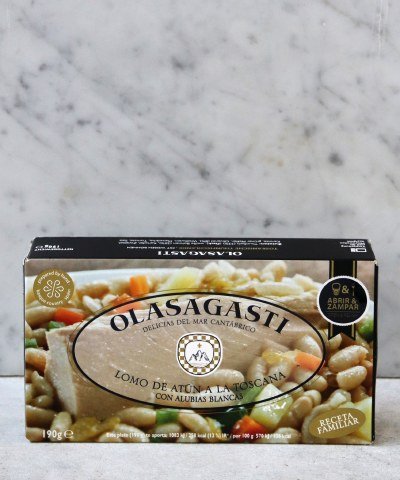
Tuna A La Toscana with White Beans, 190g
At DeLaurenti Specialty Food and Wine: Seattle specialty food market at Pike Place Market with a strong imported conservas and tinned fish selection alongside Italian and Mediterranean pantry products.
Visit store →The Market Report: the week's real price drops and deals. Free, every Saturday.
Join the list
The Tin
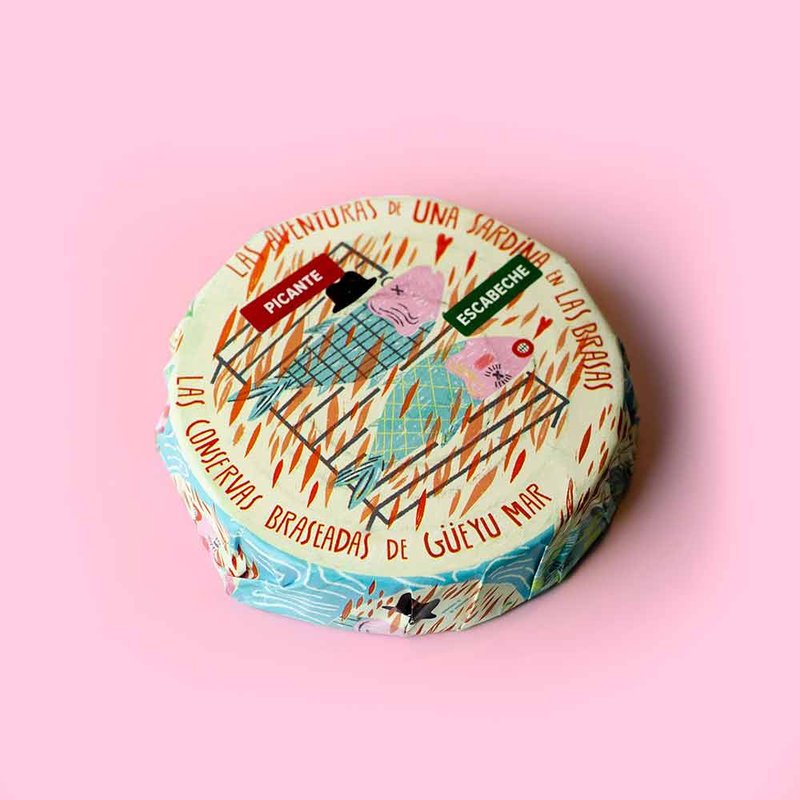
Chargrilled Sardine Tails in Spicy Escabeche
In the issue, 26 September
$21.99
Today, 26 September
$21.99Unchanged
A summer restaurant on a beach that took up canning to stay open all year.
Güeyu Mar is a small restaurant on Playa de Vega, on the Asturian coast by Ribadesella, and for most of its life it has been a summer place. Around 2017 its chef, Abel Álvarez, started canning, partly because he wanted conservas good enough to serve at his own tables, and partly to keep the staff of a seasonal restaurant working all year. The tins are made there in Vega.
Everything goes over the fire before it goes into a can. Each piece is grilled on its own over holm oak embers, and because the smoke does some of the seasoning, the tins need less salt than a conventional pack. The oil is Arbequina extra virgin from Castillo de Canena.
These are the tail ends of large sardines, grilled until the skin blisters and then packed in a spicy escabeche of that oil, cider vinegar and chili, which keeps the smoke bright rather than heavy. Álvarez's own advice is to warm the tin very gently and no more, then lay the tails on toasted bread and spoon the escabeche over.
What are you opening this week? Tell us →
The Net
No. 2: is the sale price really a sale?
Plenty of tins online come with a second price, crossed out. Was $12, now $9. The strikethrough is the retailer telling you that you are paying less than usual. We record the prices of thousands of tins, so we can check.
This week, 73 of the listings we track in US dollars showed a crossed-out price. For 39 of them, we have never seen the crossed-out price charged. Every price we have recorded for those tins is the one on the page today. The sale is the price.
Twenty were charged the crossed-out price at some point, which makes them real sales. The other 14 moved around but never reached the price shown as the old one. This week's Sale, Dovgan's Riga sprats at Euro Food Mart, is one of the real ones: $4.59 when we started tracking it this month, $3.99 now.
A standing discount can still be a fair price. It just isn't a sale. When a tin you like shows a crossed-out price, the useful question is what it cost last month.
We'll run this count again at the end of the year, when the holiday markdowns arrive.
The Radar
The US sets preliminary duties on Chinese tinplate.
Commerce set a 66.61 percent countervailing duty on tin mill products from China, the steel sheet food cans are made from, on 15 September, then a preliminary antidumping margin of about 130 percent two days later. Final determinations are due at the end of November, and the same case covers Taiwan and Turkey.
Fishwife puts its tin art on a beauty eye mask.
Fishwife and the skincare brand Dieux released a limited-edition reusable eye mask on 22 September, $25 in a collectible tin drawn by Fishwife's in-house illustrator. It is the brand's latest appearance well outside the fish aisle, after an Aldi run in August and $20 tins sold as concert merch this month.
The Find
“Sardines with ketchup & hot sauce? ...and banana??”
A poster on r/CannedSardines picked this one up from a Jamaican friend: sardines with ketchup and hot sauce, with bananas, boiled green bananas or plantains alongside, a plate the poster says is common across Jamaica and the Caribbean. The friend's own version is a sandwich of sardines, bananas or plantains, eggs and ketchup. Half the thread reached for the police ("Fish with bananas? Straight to jail"), and the other half recognized it at once, one reader adding that their mom makes saltfish with bananas all the time, and most agreeing a starchy plantain would carry it best. What sounds like a dare in one kitchen is an ordinary lunch in another.
Read on r/CannedSardines →What are you opening this week? Tell us →
The Close
Next week: the container, not the contents. The steel sheet, the printing on it, the pressure it rides out, and the ring you pull without thinking.
Was this issue useful?
Writing about tinned fish? Our data is quotable with attribution. Get in touch →