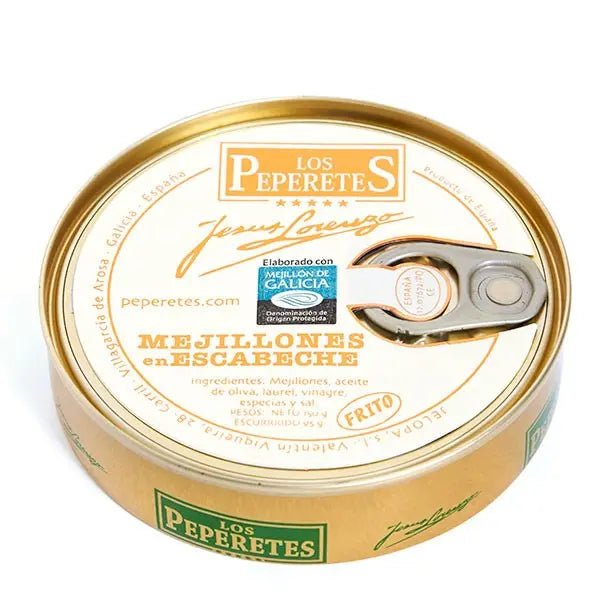
Almost everything else that you can find in the aisle was hunted. The sardine was chased through the dark by a boat with lamps, the tuna pulled one hook at a time, the anchovy netted in its brief spring run. The mussel on the other hand was not caught at all. It was grown, hung on a rope from a wooden raft in a Galician bay and left to filter the sea until it was ready, then it was sealed in a sauce that's a thousand years older than the can holding it. The humblest tin on the shelf, mussels in escabeche, turns out to be the meeting of the newest way of taking food from the sea and one of the oldest ways of keeping it.
Starting with the raft, because it is the strangest part. Off the coast of Galicia, in the sheltered inlets called rías, some thirty-three hundred wooden platforms sit anchored over deep water. These are called the bateas, and from each one of these hang hundreds of ropes reaching down deep into the dark, thick with mussels that fixed themselves there as larvae and never moved again. A mussel is a filter feeder: it eats by pulling the water through itself, and a rope hung in the right water grows a harvest without a single thing being fed to it. Each full rope weighs around three hundred kilos, and the bateas of Galicia together land some two hundred and seventy thousand tonnes a year, close to half the mussels on earth, a farming scale beaten only by China.
The Galician rías are continuously fed by cold Atlantic water pushed up from the deep, and that upwelling carries the plankton that the mussels strain out, so a mussel on a Galician rope will reach full size in about seventeen months, faster than almost anywhere else, and it comes up clean because the animal has spent a whole life scrubbing the estuary. It is a farmed food that behaves just like wild food, and the rope-and-raft method that produces it is barely older than the tin trade it feeds, pioneered in the rías in the middle of the last century.
The sauce is the opposite: it is very nearly as old as the art of cooking. Escabeche is a preparation of fried or poached fish steeped in vinegar, and its name comes through Andalusian Arabic from the Persian sikbaj, a sweet-and-sour vinegar stew eaten in the Sasanian empire more than fifteen hundred years ago. The Moors carried it across the Mediterranean into Spain, where it did what vinegar does: it kept fish edible for weeks in a world with no refrigeration. It also happened to be meat free, which made it useful on the many fasting days of the Catholic calendar, and by the time it appears in a Spanish cookbook in 1324 it is thoroughly Spanish. The tin of mussels in escabeche is that ancient trick, unchanged, with a lid on it.
The lid is the most recent part. Galicia learned to can in the nineteenth century, when the sardine deserted the French coast, when French money and know-how came south to the richest fishing grounds in Europe. Juan Goday opened the first industrial cannery in the Ría de Arousa in 1879, and within a few decades the rías were lined with factories sealing the local catch in oil and in escabeche. When the bateas arrived and mussels became something Galicia had by the hundred thousand tonnes, the cannery and the raft found each other, and the escabeched mussel became the everyday tin it still is today.
So the little oval tin you can buy for a few euros, the one people walk past on the way to the fancier sardines, holds more history than almost anything near it. The animal inside was farmed on a rope in the cleanest way anyone has worked out to take protein from the sea, and it sits in a sauce a Persian court would recognise. Open one onto bread, or over rice, and let the vinegar and the plump mussel do the work. It is the cheapest serious thing to eat in the aisle.