MrTinned
MarketPricesDeals
© 2026 MrTinned. Independent. Not affiliated with any retailer or brand.
Privacy Policy·Terms of Use·Report an issue
Prices may contain errors or be out of date.
Spotted something wrong? Let us know → We're always improving.
MarketPricesDeals
MrTinned Report, Issue 8
The one preparation that turned a Mediterranean fish into the backbone of your cooking, a whitefish tin from the inland seas, and a Basque anchovy at a fifth off. ‌ ‌ ‌ ‌ ‌ ‌ ‌ ‌ ‌ ‌
MrTinned Report
Issue 8 Saturday, 4 July 2026 Weekly
The Open
Saltand the Slow Miracle.

The best anchovy you have ever eaten did not taste like an anchovy. It was dissolved into a Caesar dressing, melted into the base of a puttanesca, or whisked into the butter spooned over a steak. It was the second ingredient in that Worcestershire sauce you shook into a Bloody Mary, present as pure savor and nothing you could name. This is the strange position the anchovy holds. It is one of the most widely eaten fish in the world, and most of the time you eat it, you have no idea it is there.

That is because the anchovy is not really a fish you eat. It is a fish you use. Fresh, Engraulis encrasicolus is a small, oily, fast-spoiling thing, unremarkable and gone within a day of the catch. What makes it the anchovy is what happens over eight to eighteen months buried in salt, packed in barrels, left while its own enzymes take the flesh apart and then rebuild it into something else. The proteins break down into glutamates, which is pure savoriness, the raw chemistry of umami. What comes out of the barrel is not so much preserved fish as it is a concentrate of the sea, or a seasoning that happens to have a spine.

People have been performing this trick for a very long time. The Romans built an empire's condiment on it: garum, a sauce of anchovies and other small fish fermented in salt, traded the length of the Mediterranean in clay amphorae, poured over nearly everything at the table. It carried its savor from the same glutamates a modern cured anchovy does, and it was made in factories whose stone vats still sit on the Atlantic coast of southern Spain, at the very edge of the same waters that later became the world's anchovy heartland. Garum never fully died. Its direct descendant, colatura di alici, is still made from salted anchovies in Campania today. The idea that a rotting little fish could be turned into the backbone of cooking is two thousand years old.

What changed in the modern era was not the cure but the container. For most of that long history the salted anchovy was a whole, bony, and forbidding thing. Sold packed in salt, to be rinsed, split, boned by hand at the moment of eating. It was closer to a raw ingredient than a finished food. Then, in 1883, in the small Cantabrian town of Santoña, a Sicilian named Giovanni Vella Scaliota worked out how to skip the labor. Vella had come north three years earlier, sent by a Neapolitan firm to salt fish, and grew tired of the cleaning ritual. He did it in the factory instead: boned the cured fish into two clean fillets, packed them in oil, and sealed them ready to eat. Sold the first ones under the name La Dolores, after the Santoña woman he had married. The Italians had brought the salting north; Vella added the oil and the tin.

The town he did it in turned out to be the perfect place for it. The anchovies of the Bay of Biscay, feeding in colder, rougher, more plankton-rich water than their Mediterranean cousins, carry more fat with a firmer flesh and they take the long salt cure better than anchovies from anywhere else. Local families took up Vella's method, and within a few decades Santoña and its neighbors along the Cantabrian coast had become the source of the finest tinned anchovies in the world. The work is still being done largely by hand. In Santoña the women who fillet the cured fish, the sobadoras, learn the exact point of a properly matured anchovy by touch, a skill passed down from mother to daughter, and it is their hands, not a machine, that produce the clean intact fillets the best tins are known for.

There is one more knot worth untangling, because it trips up nearly everyone. The anchoa and the boquerón are the same animal. In the salt-cured, oil-packed form from the Cantabrian north it is anchoa, the dark, deep, savory fillet. When marinated fresh in vinegar and oil, pale and sharp and mild, the very same fish is a boquerón. Same species, opposite preparations, and the difference is entirely in what was done to it after the catch. It is the clearest possible lesson in the thing this whole newsletter keeps circling: with tinned fish you are almost never buying the fish, you are buying the method.

The anchovy sits at the end of a very long chain. A Mediterranean bait-fish, cured the better part of a year, filleted by hand, sealed in oil by a trick a homesick Sicilian worked out in a Spanish fishing town a hundred and forty years ago, itself the descendant of a Roman sauce two thousand years older than that. You have eaten its work a hundred times without once meeting it directly. It is worth, at least once, buying a good tin and tasting the fish alone, on bread, with a little of its own oil, and no dressing to disappear into. The backbone of everything, for once in the foreground.

The Database
Here is what happened this week.
28
NEW PRODUCTS
33
RESTOCKED
43
PRICE CHANGES
28
SOLD OUT
0
NEW BRANDS
0
NEW RETAILERS
Figures captured at publication. The market is live and always shifting at mrtinned.com.
Twenty-eight products added this week, no new brands or retailers. The main work was a reconciliation pass that now runs after every scrape: when a retailer drops a tin from its feed, the system marks it sold out within two runs instead of leaving it showing as in stock.
The Move
Da Morgada mackerel in piri piri drops to $10 at Zingerman's.
Da Morgada's mackerel in piri piri has dropped from $15 to $10 at Zingerman's. Da Morgada is a Portuguese house, and this is the plain argument for Portuguese mackerel: firm fillets, good oil, and enough chili heat in the piri piri to carry a meal rather than a snack. Flake it over rice, or eat it straight on bread to let the oil and the heat do the work. A real drop on a tin worth keeping around.
$10.00
$15.00
33% OFF
Buy now →
The Tin
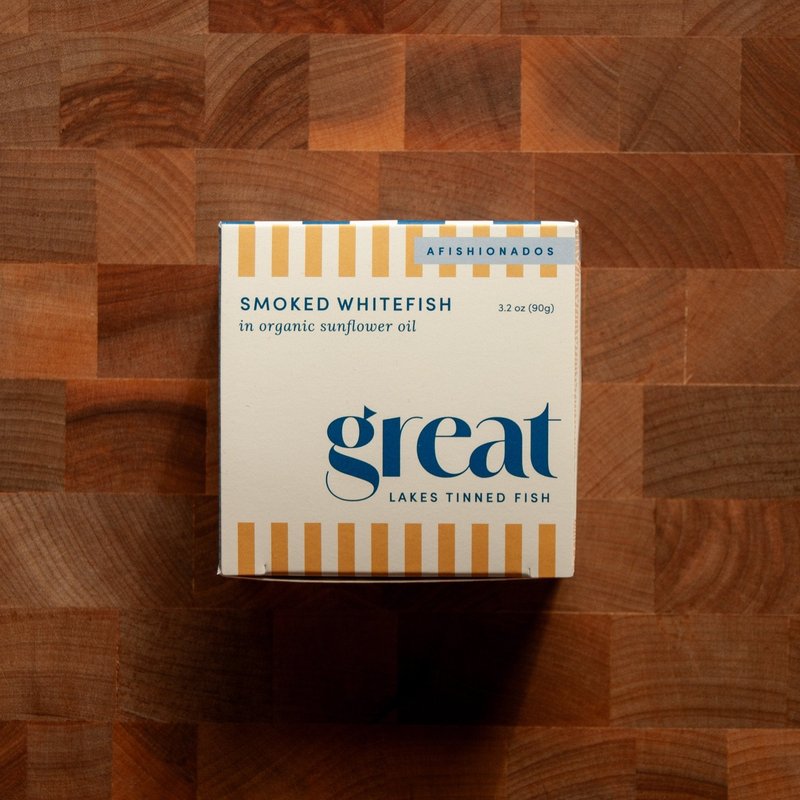
Smoked Whitefish
Smoked Whitefish
GREAT LAKES TINNED FISH · MICHIGAN · FISHNOOK

The inland sea, in a tin.

Almost every tin in the aisle comes out of salt water. This one comes out of a lake. Great Lakes Tinned Fish cans whitefish from the freshwater inland seas it is named for, and as far as its founder knows, it is the only company sourcing its fish entirely from the Great Lakes.

It is barely a year old, and the story of how it started is a good one. Marissa Fellows was living in Boston, eating her way through tinned fish at a wine bar where a tin of José Gourmet became her way in. What struck her there was that the Great Lakes, ringed by fish and by people who love them, had nothing of the kind. So she moved back to Michigan to build it, choosing whitefish because in the Midwest it is the taste of summer itself. She cold-smokes it, gently, because that keeps the fish delicate and mild rather than heavy, and she sources it from a longtime fishery on Lake Superior.

What you get is a tin with a different accent from the Iberian and Portuguese houses that fill most of the shelf, and that is exactly the reason to reach for it. Fellows talks about the smaller Great Lakes fish, the smelt and the chub, as the region's answer to the sardine. This is where it starts: the ambition of a tradition just now teaching itself to can, a freshwater fish, smoked and sealed, tasting of a particular lake and a particular summer.

$15.99 at FishNook.

Buy now →
What are you opening this week? Tell us →
The Deal
Brindisa takes a fifth off Ortiz anchovies.
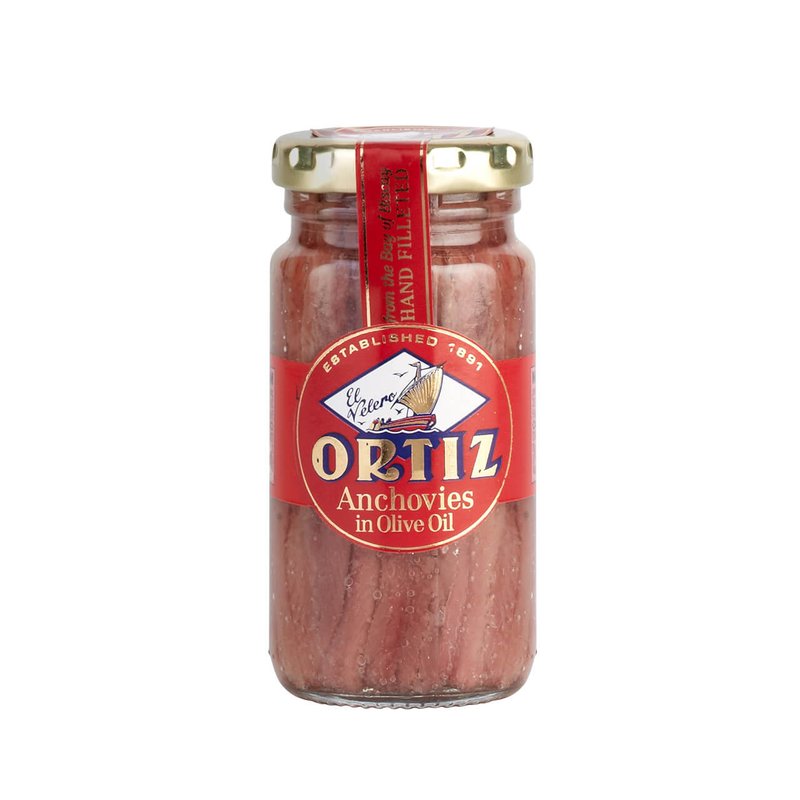
Ortiz has been salting anchovies in the Basque port of Ondarroa since 1891, and its small cured fillets are the benchmark most others are measured against: hand-filleted, matured in salt, packed in oil, clean and deep rather than sharp. Brindisa has them at a real 20 percent off. The one caveat is shipping, Brindisa sends from the UK, so this is a stock-up-and-justify-the-postage tin rather than a single-can order. At a fifth off, it might be worth it.
£11.96
£14.95
20% OFF
Buy now →
The Find
“Am I crazy? Why are TIN fish soo expensive?”
The most talked-about thread in the tinned fish world this week, on r/tinnedfish, is the question every newcomer eventually asks out loud: why does a small tin of fish cost what it costs. The answers were a good education. Some of it is the fish itself, hand-filleted anchovies or belly cuts that take real labor; some of it is import distance and small-batch scale; and some of it, the thread admitted, is simply that a beautiful label lets a brand charge more. The useful takeaway was learning to tell which is which, the tin that is expensive because of what is inside it from the tin that is expensive because of how it looks. Which is, more or less, the whole game.
Read the thread →
The Close
Next week: a fish that begins its life as a scrap of glass drifting in from the sea, that no one has ever managed to breed in captivity, and that Europe, Japan, and the Basque country each turn into something completely different.
Was this issue useful?
Yes → No →
This newsletter is new and growing entirely by word of mouth. If you found it useful, forwarding it to a friend or discussing it on Reddit means more than you might think.

~ Alex
MrTinned / AllTinned Unsubscribe · View in browser
© 2026 MrTinned. All rights reserved.
PO Box 2941, Winnetka, CA 91396, US
You are receiving this because you subscribed at alltinned.com or mrtinned.com.